
The Toad That Gives Birth Through Its Own Back
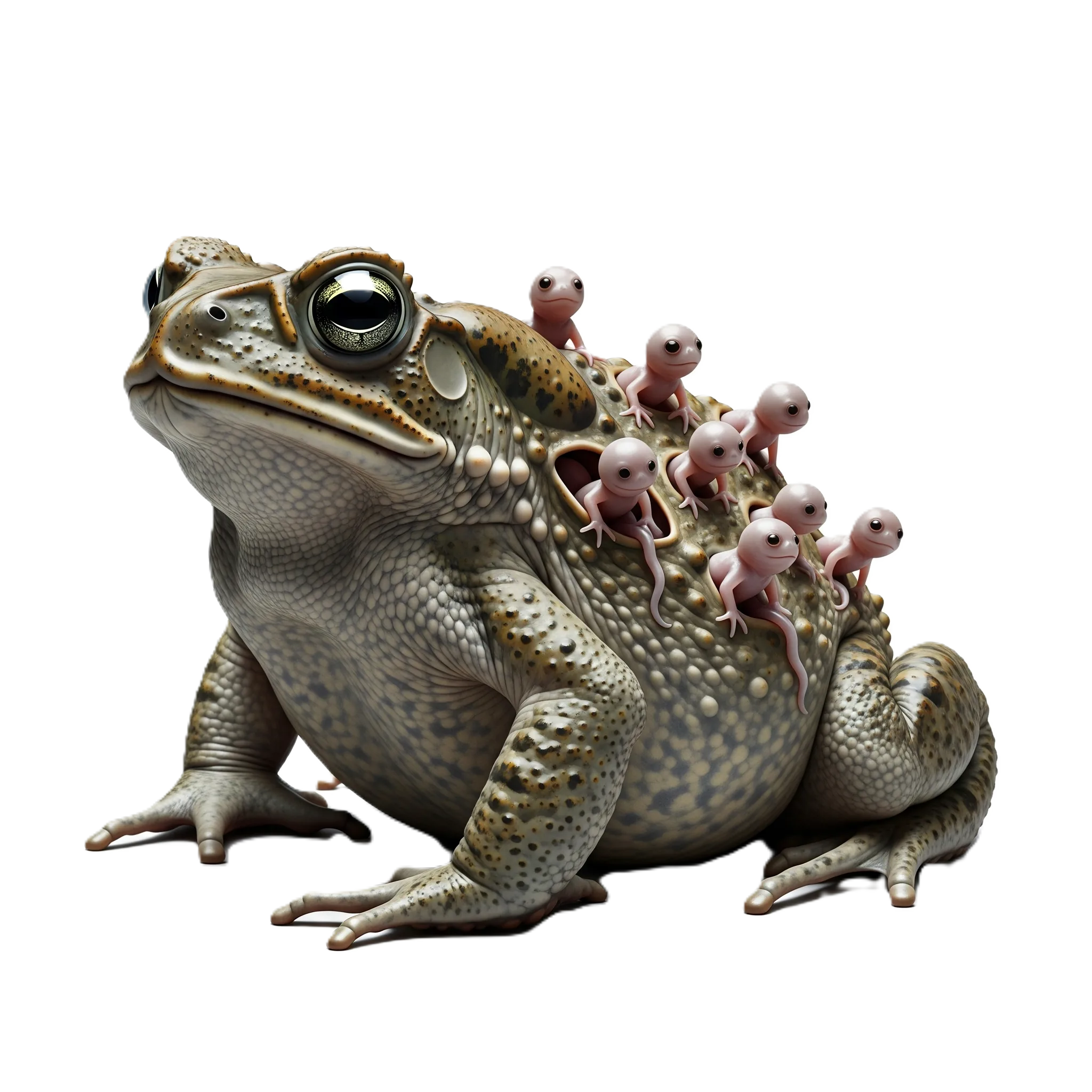
The Surinam toad doesn't lay eggs in a pond. The eggs sink into the skin of the mother's back, seal over, and grow there — until dozens of fully formed toadlets erupt out of her, all at once.

Specimen classification
Type
Aquatic frog
Lives
Amazon basin, South America
Eggs on her back
Up to ~100
Skips
The tadpole stage entirely
Most frogs lay eggs in water, the eggs hatch into tadpoles, and the tadpoles slowly grow legs. The Surinam toad skips all of that. Its babies grow inside the skin of their mother's back — and then climb out of it.
It is flat, it has no tongue, and it carries its children like a living honeycomb. Nature did not have to do this. It did it anyway.
Surinam Toad


This fact has been locked for your safety.
A frog built like a soggy leaf
The Surinam toad looks less like an animal and more like something that fell off a tree and got wet. Its body is almost completely flat and brown, which makes it nearly invisible against the muddy bottom of slow Amazon rivers.
It has no tongue to catch food. Instead, the tips of its fingers end in tiny star-shaped points that feel around in the murky water. When they touch something edible, the toad lunges and vacuums it in.
Weird detail
Its star-tipped fingers are sensors, not claws. The Surinam toad basically tastes the water with its hands.
The underwater somersault
When it is time to breed, a pair performs a slow series of underwater somersaults. Each time they loop through the water, the female releases a few eggs and the male presses them onto her back as they tumble.
By the end of the dance, dozens of sticky eggs are stuck across the mother's back in neat rows. And then something strange starts to happen to her skin.
Science bit
The whole egg-placing dance is done in the water, upside down and right-side up, over and over — sometimes for hours.
Skin like a honeycomb
Over the next day, the mother's back swells and grows up and around each egg until they sink in completely. Each egg ends up sealed inside its own little pocket of skin, like a living bubble wrap of babies.
For the next three to four months, the young grow in those pockets — egg, then embryo, then a proper little toad — fed and protected inside their mother's back the entire time. No pond. No tadpoles swimming around. Just skin.
Danger
There is no free-swimming tadpole stage at all. The babies go from egg to fully formed toad without ever leaving her back.
The eruption
When they are ready, the toadlets push the lids off their pockets and haul themselves out of their mother's back — sometimes dozens of them, wriggling free within minutes of each other. Fully formed, miniature, and immediately on their own.
Afterwards, the mother often sheds the used layer of skin, leaving her back smooth again — ready, eventually, to do the whole thing over.
Weird detail
Videos of the toadlets emerging are famously hard to watch. The science word for fear of clustered holes — trypophobia — gets a real workout here.

Dr. Icky's verdict
“I have watched this footage 41 times. I have not enjoyed it once. And yet — no pond, no tadpoles, the babies just walk out of mum. That is brilliant, efficient, and deeply, profoundly upsetting. Full marks.”
Classify it yourself
234 specimens are waiting
Scan this specimen, survive the quiz, and master it in the free app — then hunt the other 233.